
Copywriting Skills for Affiliate Marketing: How to Write Messages That Convert
🔑 Key Takeaways
Copywriting for affiliate marketing is not about hype, pressure, or clever sales tricks. It is about clear communication.
Good affiliate marketing copy helps people understand the problem, the solution, and why your recommendation makes sense.
Copywriting supports traffic and conversions because it affects your headlines, hooks, emails, landing pages, bridge pages, and calls to action.
Helpful copy usually converts better than hype copy because it builds trust and makes the message feel relevant.
Beginners can improve their copywriting skills by writing consistently, studying audience questions, testing headlines, improving emails, and simplifying their calls to action.
Copywriting Skills for Affiliate Marketing
Affiliate marketing has many moving parts.
You need traffic.
You need a system.
You need an offer.
But there is one skill that connects all of it together. Copywriting.
Without clear copy, traffic gets wasted. Landing pages confuse people. Emails feel disconnected. Bridge pages fail to explain the recommendation. Even a good affiliate offer can feel random if the message around it is weak.
That is why copywriting is one of the most important affiliate marketing skills to learn.
But here is where many beginners misunderstand it..
They think copywriting means writing aggressive sales lines, using hype, adding fake urgency, or making big promises. I do not see it that way. Copywriting is the skill of helping people understand.
It helps someone understand the problem they are facing, why that problem matters, what solution could help, and why your recommendation may be relevant.
That is the real job of copy.
Not to pressure.
Not to manipulate.
Not to sound clever.
Just to communicate clearly.
When you understand copywriting this way, affiliate marketing becomes much simpler. You stop trying to “sell harder” and start learning how to explain better.
And when your message becomes clearer, your traffic, your emails, your funnels, and your offers all become more effective.
What Is Copywriting in Affiliate Marketing?
Copywriting in affiliate marketing is the skill of writing messages that help people take action.
That action could be joining your email list, clicking a link, watching a video, reading a blog post, or buying through your affiliate recommendation.
But action does not happen just because you put a link in front of someone.
It happens because the message makes sense.
Effective affiliate copywriting connects three things:
Your audience’s problem → The solution they want → The offer you recommend
For example, if someone is struggling to get results online, you could say:
“Click here to start affiliate marketing.”
But that does not say much.
It does not explain the problem. It does not create context. It does not show why the next step matters.
A clearer message would be:
“If you are getting traffic but not building leads, you may not need another traffic source. You may need a simple system that helps turn visitors into subscribers and trust.”
That message works better because it speaks to a real problem. It meets the reader where they are. It makes the next step feel logical.
That is copywriting.
It is not just words on a page. It is the way you guide someone from confusion to clarity.
Affiliate copywriting can show up in many places, including emails, landing pages, bridge pages, social media posts, video scripts, blog intros, headlines, and calls to action.
Every time you ask someone to take a step, copywriting is involved.
Why Copywriting Matters for Affiliate Marketing Conversions
Many beginners believe traffic is the main problem. And in many ways, it is. If nobody sees your content, nobody can click, join your email list, or buy through your recommendation.
But traffic alone is not enough.
If the message is unclear, people leave.
If the offer is not positioned properly, people feel disconnected. If the next step is confusing, people do nothing. This is why copywriting matters for affiliate marketing conversions. Copywriting gives traffic direction.
It helps your visitor understand why they should care, what they should pay attention to, and what they should do next..
For example, a weak message might say:
“Click here to get this amazing affiliate marketing tool.”
That message is too general. It does not explain why the tool matters or what problem it solves.
A stronger message would say:
“If you are getting traffic but not building leads, you may not need another traffic source. You may need a simple follow-up system that helps turn visitors into subscribers and trust.”
That message works because it speaks to a real situation. It shows the reader you understand the problem behind the problem. That is what good conversion copy does. It does not just promote the offer. It positions the offer.
And when the offer is positioned clearly, conversions become easier.
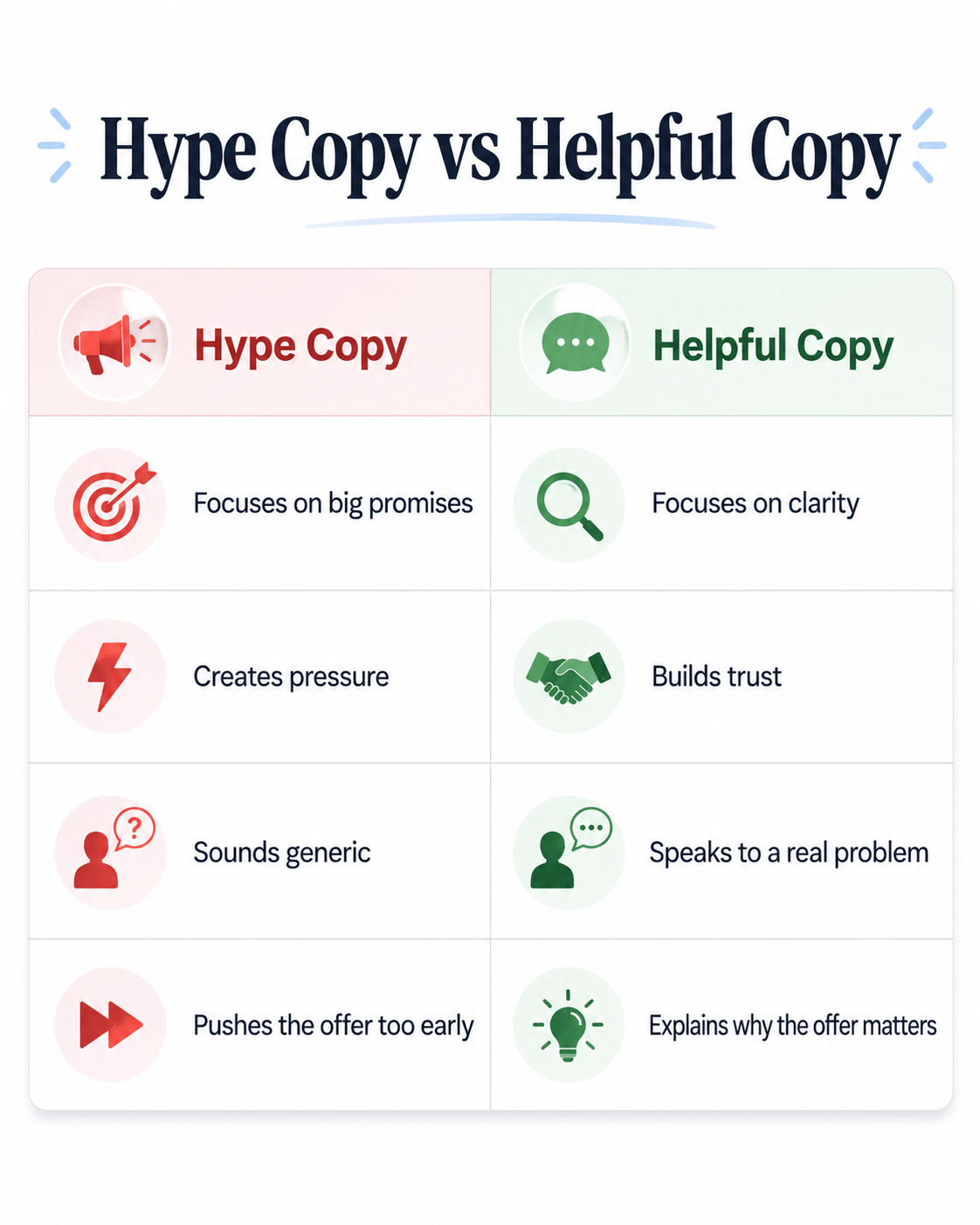
Here is an example of hype copy:
“Click here to make money fast with this amazing system.”
That kind of message may get attention, but it often creates skepticism. It sounds like every other promise online.
Now compare that with helpful copy:
“Learn how to build a simple affiliate system that turns traffic into leads before promoting an offer.”
That message is calmer. But it is stronger. Why? Because it explains what the person is learning. It gives context. It speaks to a real problem. It feels more believable. And believable copy is powerful.
Especially in affiliate marketing.
People are tired of exaggerated promises. They want clear explanations, practical steps, and recommendations that feel honest.
That is why helpful copy usually converts better than hype copy.
How Copywriting Supports Traffic and Conversions
Traffic and conversions are two major skills in affiliate marketing. But copywriting supports both. On the traffic side, copywriting helps you create better hooks, titles, intros, captions, headlines, and content ideas. It helps you get attention from the right people.
Not just anyone.
The right people.
For example, a vague headline might say:
“Affiliate Marketing Tips”
A stronger headline might say:
“Why Your Affiliate Traffic Is Not Turning Into Leads”
The second headline is more specific. It speaks to a real frustration and attracts someone who already has a problem they want to solve. That is how copy supports traffic. On the conversion side, copywriting helps people take the next step.
Your landing page headline needs to explain the value. Your emails need to build trust. Your bridge page needs to explain why the offer matters. Your call to action needs to feel clear.
Without copywriting, the system may exist, but the message inside the system is weak.
And a weak message makes every part of your marketing harder.
Traffic brings people in. Conversions guide them forward. Copywriting explains why they should care.
How to Write Affiliate Emails That Convert
Email is one of the best places to practice copywriting.
Why?
Because email is a conversation. At least it should feel like one. A good affiliate email does not need to be complicated. It should usually do three things:
It should connect with the reader.
It should teach or clarify something useful.
It should give a clear next step.
Many beginners write emails that feel like promotions. They only send messages when they want someone to click or buy. But if every email feels like a pitch, trust starts to drop.
A better approach is to use email to guide the reader.
You can share a story. You can explain a mistake. You can teach a small lesson. You can show why a problem matters.
Then, when you introduce an offer, it feels connected to the conversation.
A simple email structure can look like this:
Story → Lesson → Connection → Clear Action
For example, instead of starting with:
“Here is a tool you should buy.”
You might start with:
“One mistake I made for years was thinking traffic was the whole game. But traffic without a follow-up system usually disappears.”
That opening creates context. It gives the reader a reason to continue. Then you can explain the lesson, connect the idea to a relevant offer, and give one clear call to action. This is how email copy becomes more natural. It does not feel like a pitch. It feels like a useful conversation.

How to Write Affiliate Landing Page Copy
A landing page has one main job. It helps the right person take one clear step. That step might be joining your email list, downloading a guide, watching a training, or accessing a resource.
The biggest mistake beginners make with landing pages is trying to say too much.
They add too many ideas, too many promises, too many buttons, and too much explanation.
But a strong landing page is usually simple.
It needs a clear headline, a short explanation of the problem or outcome, a reason to take action, and one clear call to action.
The headline is especially important because it tells the visitor whether they are in the right place.
A vague headline might say:
“Start Your Online Business Today.”
A clearer headline might say:
“Learn How to Turn Affiliate Traffic Into Leads and Trust.”
The second headline is more specific. It tells the visitor what they will learn and connects to a real problem. Good landing page copy is not about attracting everyone.
It is about attracting the right person and making the next step obvious.
How to Write Affiliate Bridge Page Copy
Bridge pages are especially useful in affiliate marketing because you are often promoting a product you do not own. That means the reader needs context before they land on the sales page. A bridge page helps create that context.
It explains why the offer matters, who it is for, what problem it solves, and why you are recommending it. Without that bridge, the offer can feel random. Someone clicks from your content and suddenly lands on a sales page from another person or company. That can feel disconnected.
A good bridge page makes the transition smoother.
It says, in simple terms:
“Here is why this next step may help you.”
That does not need to be long. It just needs to be clear.
For example, if your content was about struggling to convert traffic, your bridge page should continue that conversation.
It might say:
“If you are getting traffic but not building leads, the next step is learning how to set up a simple follow-up system. This training shows how that process works.”
That kind of message connects the problem to the offer. It does not hype. It does not exaggerate.
It explains. That is what strong bridge page copy does.
Common Affiliate Copywriting Mistakes Beginners Make
Most beginner copywriting mistakes come from trying too hard.
People try to sound professional. They try to sound persuasive. They try to copy what other marketers are saying.
And the message ends up sounding generic.
Using Vague Hype
Phrases like “change your life,” “unlock success,” or “make money fast” sound big, but they do not explain anything.
Specific copy is usually stronger.
Instead of saying:
“Unlock your path to financial freedom.”
Say:
“Learn how to build a simple email follow-up system before sending traffic to an offer.”
That tells the reader what they are learning and why it matters.
Listing Features Instead of Benefits
A beginner may write:
“This tool has funnels, email automation, and templates.”
That is useful, but it is not enough.
A better message would explain what those features help the person do:
“This helps you capture leads, follow up automatically, and give your traffic a clear next step.”
Features explain what something has. Benefits explain why it matters.
Writing Weak Calls to Action
If the reader does not know what to do next, they probably will not do anything. The next step should always feel obvious.
Use direct, simple calls to action like:
Read the full breakdown here
Watch the free training
Access the guide
Start here
Simple usually works better.
Pitching Too Early
Another mistake is introducing the offer before the reader understands the problem. If the reader does not feel understood, they will not trust your recommendation. Explain the problem first. Then introduce the solution.
How to Improve Your Affiliate Copywriting Over Time
Here's a story most affiliate marketers never tell.
They spend weeks building their funnel. They research the offer, set up the landing page, connect the autoresponder, and drive traffic. Then they sit back and wait for the results.
The traffic comes in. And almost nothing happens. No opt-ins. No clicks. No replies.
They assume the problem is the offer. Or the traffic source. Or the niche.
So they start over — new offer, new funnel, same result.
What they never stop to examine is the copy. The actual words on the page. The subject line nobody opened. The CTA nobody clicked. The email that sat unread in 400 inboxes.
This is where most affiliate marketers stay stuck — not because they lack strategy, but because they never develop the one skill that ties every other piece together.
The good news? Copywriting is learnable. But it improves the same way every real skill improves: through repetition, honest feedback, and paying close attention to what actually works.
Step 1: Write More Than You Think You Need To
The biggest mistake new affiliate marketers make is treating copy like a one-time task. They write one email sequence. One landing page. One set of social captions. Then they move on.
That's not how the skill develops.
The affiliates with the sharpest copy write constantly — emails, headlines, hooks, CTAs, bridge page scripts — and they treat every piece as a live experiment. Some of it works. A lot of it doesn't. But every piece teaches them something.
Think of it like a muscle. The first time you write a subject line, it's awkward. You're not sure what's too salesy or too vague. But after writing fifty subject lines and watching your open rates fluctuate, you start to develop instincts that no course can give you.
Start here: Commit to writing one piece of copy every day for 30 days. It doesn't have to be long. A subject line. A headline. A three-paragraph email. A caption. The consistency matters more than the length.
Step 2: Let the Metrics Tell You the Truth
Here's what separates copywriters who improve from those who plateau: they stop guessing and start listening to the data.
Your metrics are honest in a way your own judgment often isn't. You might love the email you just wrote. Your audience might ignore it entirely. You might think a headline is too direct — and it triples your click-through rate.
The numbers don't have opinions. They just show you what's connecting.
Pay attention to:
Open rates — Is your subject line sparking enough curiosity to earn the click?
Click-through rates — Is the body of your email building enough trust and relevance to make the reader want to take the next step?
Opt-in rates — Is your landing page headline speaking directly to the right person's pain point?
Reply rates — Are your emails human enough that people feel compelled to respond?
A 20% open rate with a 0.5% CTR tells a different story than a 40% open rate with a 2% CTR. Both numbers point to something specific — and both give you a direction to move in. Don't just collect the data. Use it. When something works unexpectedly well, reverse-engineer why. When something falls flat, ask yourself what assumption you made about the reader that turned out to be wrong.
Step 3: Mine Your Audience's Own Words
This is the single most underused copywriting technique in affiliate marketing — and arguably the most powerful one.
Your audience is already telling you exactly what to write. You just have to stop and listen.
Every comment on your posts, every reply to your emails, every question in a Facebook group, every review on a competitor's product page — these are not just feedback. They are raw material. The unfiltered, unedited language of the exact person you're trying to reach.
Imagine you're promoting a time management tool. You could write: "Boost your productivity with this powerful system." Or you could spend twenty minutes reading comments in a busy productivity forum and discover that your audience's real language sounds like this: "I get to the end of the day and I have no idea where the time went" or "I make a to-do list every morning and somehow it never gets done."
Which copy do you think lands harder?
When your words mirror the thoughts already running through your reader's head, your marketing stops feeling like marketing. It feels like recognition. And recognition creates trust faster than any sales technique ever could.
How to build your audience language library:
Screenshot comments and replies that express real frustrations
Save questions people ask repeatedly in forums and groups
Read one-star reviews of products in your niche (people are brutally specific about what disappointed them)
Pay close attention to the exact phrasing people use — not the sentiment, but the specific words
Then weave that language directly into your headlines, email openers, and CTAs. You'll be stunned by how much more alive your copy feels when it's built from your audience's own vocabulary.
Step 4: Test One Variable at a Time
Improvement without testing is just opinion. And in copywriting, your opinion is almost always less accurate than you think.
The good news is you don't need a sophisticated setup to start testing. You just need discipline: change one thing at a time, measure the result, and move on to the next test.
Simple tests to run immediately:
Send the same email to two segments with different subject lines and compare open rates
Try two different CTA button labels on your landing page and see which drives more opt-ins
Write two different email openers — one that leads with a question, one that leads with a story — and watch which generates more replies
Test a short landing page against a longer one and let the conversion rate decide
The key is patience. Changing five things at once tells you nothing. Changing one thing at a time, consistently over weeks and months, builds a library of insights specific to your audience that no course or template can give you.
Step 5: Study Copy That's Already Working
Before a copywriter becomes original, they become a student.
Find affiliate emails that make you want to keep reading. Save landing pages that almost made you buy something. Screenshot CTAs that feel effortless. Study them — not to copy them, but to understand what's happening structurally.
Ask yourself: What did the opening line do? Where did they introduce the problem? When did they mention the offer? What did the CTA say, and why does it feel natural rather than pushy?
Dissecting copy that works is one of the fastest ways to internalize patterns you can then adapt in your own voice.
Using AI to Write Better Affiliate Copy (Without Losing Your Voice)
AI tools have genuinely changed what's possible for affiliate copywriters — especially solo marketers who used to spend hours staring at a blank screen trying to get started.
Used well, AI can help you break through the blank page, generate ten headline variations in seconds, restructure a rambling email draft into something clean and readable, and spot places where your argument loses momentum.
But there's a limit — and it matters.
AI has never been confused by a product page that promised too much. It's never felt the specific frustration of trying to build an audience from zero while working a full-time job. It's never had a mentor whose advice changed the direction of its business. Those experiences are yours. And they are what make copy feel real.
The best affiliate copy doesn't just communicate information. It communicates understanding. The sense that the person writing it has been exactly where the reader is right now — and found a way through.
That's something AI can approximate but never replicate.
The right way to use AI in your copywriting process:
Use it to generate rough drafts and headline options — then rewrite in your own voice
Ask it to help you simplify overly complex explanations
Use it to brainstorm angles you haven't considered
Let it clean up grammar and flow — but don't let it flatten your personality out of the copy
The output of AI is a starting point. Your job is to make it sound like you wrote it — because the reader is there for you, not for a polished algorithm.
In a world where AI-generated content is becoming increasingly common, the affiliate marketers who build lasting audiences will be the ones who sound unmistakably human. That takes practice, self-awareness, and a willingness to keep writing until your voice comes through clearly on the page.
And that, more than any tool or tactic, is what separates the affiliates who build real businesses from the ones who are still searching for the shortcut.
Final Thoughts: Clear Communication Converts Better Than Hype
Copywriting is not about tricks. It is not about pressure.
And it is definitely not about sounding like every other marketer online.
Copywriting is about communication.
It is about helping someone understand the problem, the solution, and the next step.
When you learn copywriting, your traffic becomes more valuable. Your emails become more useful. Your landing pages become clearer. Your bridge pages become stronger.
And your recommendations feel more relevant.
That is why copywriting is one of the most important affiliate marketing skills you can learn.
Because once you improve the message, everything else becomes easier to improve.
The goal is not to sell harder.
The goal is to communicate better.
That is what builds trust. And trust is what makes conversions possible.

❓ Frequently Asked Questions
What is copywriting in affiliate marketing?
Copywriting in affiliate marketing is the skill of writing clear messages that help your audience understand a problem, see the value of a solution, and take action through your affiliate recommendation..
Do beginners need copywriting skills for affiliate marketing?
Yes. Beginners need copywriting skills because copy affects emails, landing pages, bridge pages, social posts, video scripts, headlines, and calls to action.
How does copywriting improve affiliate sales?
Copywriting improves affiliate sales by making your message clearer. It helps the reader understand why your recommendation is relevant and what step to take next.
What is the difference between content writing and copywriting?
Content writing usually educates, entertains, or informs. Copywriting guides the reader toward a specific action, such as clicking, subscribing, watching, or buying.
How do I write better affiliate emails?
Write affiliate emails like a conversation. Share a story, teach a lesson, connect the lesson to the offer, and give a clear next step.
What is landing page copy?
Landing page copy is the text on a page designed to help someone take one specific action, such as joining your email list or accessing a resource.
What is bridge page copy?
Bridge page copy explains why you recommend an affiliate offer before sending someone to the sales page.
Can AI help with affiliate copywriting?
Yes. AI can help with drafting, brainstorming, and editing. But your personal experience, voice, and understanding of your audience are what make the message feel real.
What is the biggest copywriting mistake beginners make?
The biggest mistake is using vague hype instead of clear, specific messaging that speaks to the audience’s real problem.
Is copywriting more important than traffic?
Traffic and copywriting work together. Traffic brings people in, but copywriting helps them understand why they should take the next step.



Let's get social


Created with © systeme.io